
Firmware Development
Optimised code for real-time microcontroller systems. Reliable connectivity and IoT features.
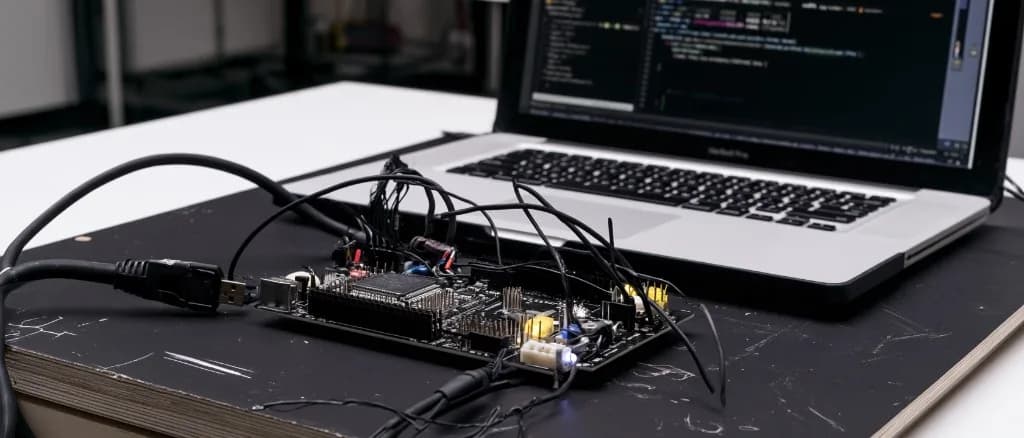
What we deliver
Bare-metal and RTOS
Scheduling, interrupt architecture, power states and deterministic timing.
Drivers and board support
Peripheral drivers, sensor integration, bring-up and hardware abstraction.
Wireless and connectivity
BLE, Wi-Fi, LoRa and cellular stacks with provisioning and telemetry.
Bootloaders and OTA
Signed images, rollback, staged rollout and field-update strategy.
Why it matters
- Hardware-aligned firmware that avoids integration delays.
- Real-time performance from RTOS or bare-metal designs.
- Protocol support across BLE, Wi-Fi, CAN and MQTT, with secure updates.
- A maintainable, well-documented code base.
- Optional embedded AI inference on device (TinyML).
What the work covers
- MCU and RTOS development in C, C++ or Rust
- Bootloader and low-level driver implementation
- Communication stacks: USB, BLE, Wi-Fi, Ethernet and CAN
- Edge-to-cloud integration over MQTT and HTTPS, with cloud SDKs
- Unit tests, hardware-in-the-loop testing and field update support
- Final firmware image, documentation and maintenance plan
- 01
Requirements gathering and architecture design
- 02
Firmware implementation and peer review
- 03
Integration testing on hardware: HIL, debug and logging
- 04
Delivery of the final firmware image and support setup
How the work is handed over
Every stage closes on a named deliverable and the client owns it: firmware source in your own Git, the built hex and bin images, a test report and an integration guide. None of it is held back as leverage over the next stage.
The code is written for the engineer who picks it up next, whoever that turns out to be. And because the same team carries the board, a peripheral that needs a different pin is a schematic change and a firmware change settled in one conversation, rather than negotiated between two suppliers after both sides are built.
- Output
- Firmware source · hex and bin images
- Documentation
- Test report · integration guide
- Languages
- C · C++ · Rust
- Silicon
- STM32 · ESP32 · nRF52 · RA
- RTOS
- FreeRTOS · Zephyr
- CI
- Automated build and unit test
- Source
- Git, client-owned

Common questions
- Do you co-develop firmware with hardware?
- Yes. Firmware and PCB are developed in parallel by the same team, so the two evolve together instead of meeting for the first time at bring-up.
- What platforms do you use?
- Most MCUs and RTOS's, STM32 with FreeRTOS, ESP32 with ESP-IDF, nRF52, Renesas RA, and the common interfaces alongside them.
- How do you handle testing?
- Unit tests, plus hardware-in-the-loop rigs that validate the firmware against the real circuit rather than against a simulation of it.